A good deal of wolf behavior and pack behavior deals
with the hunting and catching of prey. These wolf activities often
evoke emotional responses in the surrounding community, from hunters
and ranchers to those people who just have strong opinions on just about
everything. A common response is that the wolves are killing all
the ungulates such as deer, elk, and moose. A variety of concerns
then stems from these notions. They range from a lack of hunting
opportunities because ungulate populations have supposedly been reduced
by the wolves, to government agencies regulating access to the national
forests in their attempt to control the number of ungulates killed by hunters.
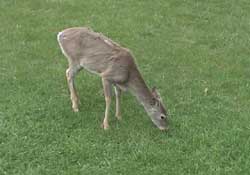 |
The notion that wolves and other predators are killing
and drastically reducing ungulate populations is not supported by the scientific
data. Several studies have been conducted demonstrating that ungulate
populations are doing extremely well, even in the presence of wolves and
other predators. The references for some papers that have been published
from northwest Montana are provided below:
Kunkel, K. E., D. H. Pletscher. 1999. Species-specific
population dynamics of cervids in a multipredator ecosystem. Journal
of Wildlife Management 63:1082-1093.
Kunkel, K. E., T. K. Ruth, D. H. Pletscher, and M. G.
Hornocker. 1999. Winter prey selection by wolves and cougars
in and near Glacier National Park, Montana. Journal of Wildlife
Management 63:901-910.
Kunkel, K. and D. H. Pletscher. 2000. Habitat factors
affecting vulnerability of moose to predation by wolves in southeastern
British Columbia. Canadian Journal of Zoology 78: 150-157.
Kunkel, K. and D. H. Pletscher. 2001 Winter hunting
patterns and success of wolves in Glacier National Park, Montana.
Journal of Wildlife Management 65: 520-530.
Kunkel, K.E., D. H. Pletscher, D. K. Boyd, R.R. Ream,
and M. W. Fairchild. 2003. Factors affecting foraging behavior
of wolves in and near Glacier National Park, Montana. Accepted by
Journal of Wildlife Management.
I received these references from Tom Meier, the U. S.
Fish & Wildlife Service biologist in charge of overseeing the progress
of wolf packs in northwest Montana. He has since moved on to Denali
National Park in Alaska. Here are some of his thoughts regarding
the local ungulate populations in northwest Montana:
I think that the conclusion of much of Kyran Kunkel's
work is that multiple predators can in fact depress populations of prey. But winter severity is probably the biggest factor in prey numbers. In Minnesota and Wisconsin, after a series of mild winters, deer are so
numerous that both states have had to steadily liberalize deer hunting
regulations in order to kill more deer. With 3000 or so wolves, Minnesota
last year, for the first time, made it possible for deer hunters to kill
as many as 5 deer in the season. Wisconsin deer regulations are even
more liberal. Here in NW Montana, I don't think anyone could dispute
that deer have come back dramatically since the last severe winter, even
as wolf numbers increased.
During the 2004 hunting season, northwest Montana reached
record levels of harvest for many of the hunted ungulate species, which helps support
the conclusions of scientific studies. Despite the evidence, however,
some people will continually insist that wolves are killing all the game
animals. Where these attitudes come from is explored in the
section on bigotry. In addition, the article Local Issues looks at how the Fishtrap pack has been blamed for killing all the deer locally. During my surveys for the wolves, I collect data on the number of deer and other animals present in the wolves' territory. The data demonstrates there is currently a great number of deer in the woods, as well as elk and moose, despite the presence of the Fishtrap pack.


